Mark-recapture: Why and how

Estimating population size

What are some reasons that an ecologist would want to know the size of a population?

Tim Peltier, a biologist for the Alaska Department of Fish and Game in Palmer, explains one of the reasons why biologists have such an important job. “We count moose, caribou, sheep, and to a lesser extent bears and wolves,” he said. “The Board (of Game) has determined the population and harvest objective in each area and we are tasked with determining how close we are to those objectives. We need to have an idea of the population size.”
- Alaska Dept. of Fish and Game
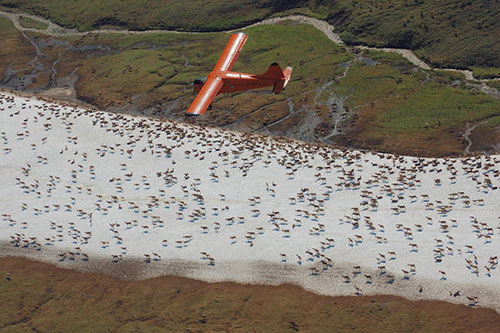
Estimating population size

What are some reasons that an ecologist would want to know the size of a population?

Most often monitoring programs are designed to help managers and policy makers make more informed decisions. Monitoring allows decisions to be based less on beliefs and more on facts. We may believe that grasshopper sparrows in New England are decreasing in abundance because grasslands are being converted to housing (Figure 1.1). Only after a rigorous, unbiased monitoring program has been in place can we say that yes, indeed, the population seems to be declining (Figure 1.2) and that the decline is associated with the loss of grasslands.
- Monitoring animal populations: A practitioner’s guide

If you wish to harvest a lake trout population, one helpful bit of information is the size of the population you wish to harvest. If you are trying to decide whether to spray a pesticide for aphids on a crop, you may wish to know how many aphids are living on your crop plants. If you wish to measure the impact of lion predation on a zebra population, you will need to know the size of both the lion and the zebra populations.
- Estimating abundance in animal and plant populations

Refresher on Mark-Recapture as a method to estimate of population size:

  1. Capture and mark (tag) some number of individuals
  2. Release tagged individuals and allow the population to re-equilibrate
  3. Once population is settled (e.g. in the case of bats - on a different night), capture some number of individuals
  4. The proportion of individuals that are marked in your second sample can give you a good estimate of the total population size

Refresher on Mark-Recapture as a method to estimate of population size:

  • \(N_{Marked}\): number of individuals marked in first sample

  • \(N_{Captured}\): number of individuals captured in second sample

  • \(N_{Captured,\ Marked}\): number of individuals in the second sample that are marked

  • \(N_{Total,\ Estimated}\): estimate of total population size

  • \[N_{Total,\ Estimated} = \frac{N_{Marked}*N_{Captured}}{N_{Captured,\ Marked}}\]

Activity for today

  • Form groups of 4 people each; each group will have two sub-groups of 2 people each.

  • Each group gets two bags with an unknown number of beans. This is your “true population”

  • I will provide each sub-group with instructions for total number of organisms to “mark”, and number to “recapture”

  • Mark the assigned number of beans with a marker once, and repeat the recapture procedure with the assigned number three times.

  • Record \(N_{Captured,\ Marked}\) each time you recapture. Estimate your population size using the formula \[N_{Total,\ Estimated} = \frac{N_{Marked}*N_{Captured}}{N_{Captured,\ Marked}}\]

  • Once you are done with 3 “recaptures”, report your results to Gaurav.