Exponential population growth
Population ecology
What defines a population?
Individuals of the same species living together
Individuals interact with one-another
e.g. mating, facilitating, competing
Photo by Jeffrey Hamilton on Unsplash
Photo by National Cancer Institute on Unsplash
How does a population grow or shrink?
- Birth (+)
- Death (-)
- Immigration (individuals coming in, +)
- Emigration (individuals leaving, -)
How does a population grow or shrink?
- Birth (+)
- Death (-)
- Immigration (individuals coming in, +)
- Emigration (individuals leaving, -)
For now, we will consider a ‘closed’ population
How does a population grow or shrink?
In a closed population, population size (\(N\)) only changes due to births and deaths
If we know the size of a population now and want to know how big it will be at some time in the future, we simply need to add the number of new births and subtract the number that died.
Note that how much time passes between now (\(t = 0\)) and “some time in the future” will depend on the specific details of our system. E.g. for bacteria growing in a petri dish or in an infected animal, you might want to track population dynamics rapidly (hourly), but for large animals, years or more might be the right timescale.
How does a population grow or shrink?
Let’s write a formula.
\[N_{t+1} = N_{t} + B - D\]
\[N_{t+1} - N_{t} = B-D\]
\[\Delta N = B-D\]
\[\frac{dN}{dt} = B-D\]
How does a population grow or shrink?
\[\frac{dN}{dt} = B-D\]
We need to know: What determines \(B\) and \(D\)?
Depends on the birth rate and mortality (death) rate:
- Total births = per-capita birth rate * number of individuals
\[B = bN\]
- Total deaths = per-capita mortality rate * number of individuals
\[D = dN\]
How does a population grow or shrink?
\[\frac{dN}{dt} = B-D\]
\[B = bN \text{ and } D = dN\]
\[\frac{dN}{dt} = bN - dN\]
\[\frac{dN}{dt} = (b- d) N\]
\[\boxed{\frac{dN}{dt} = rN}\]
Populations grow when there are more births than deaths (\((b-d) > 0\); aka \(r > 0\))
Populations shrink when there are more deaths than births (\((b-d) < 0\); aka \(r < 0\))
The magnitude of \(r\) determines the rate of growth
How can such a simple population model help?
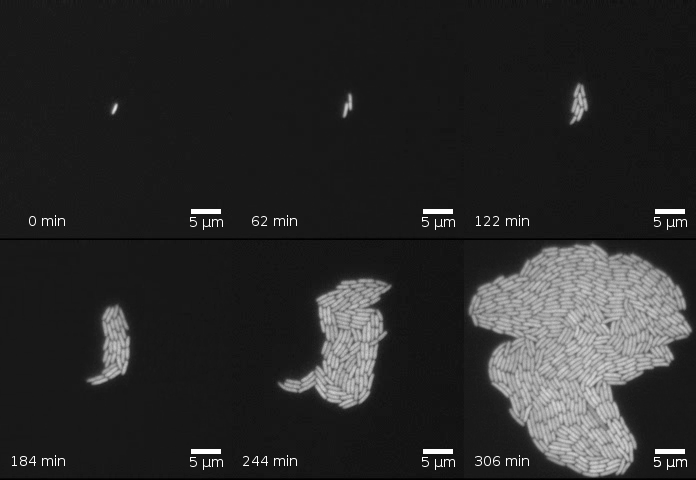
Source: Wikimedia
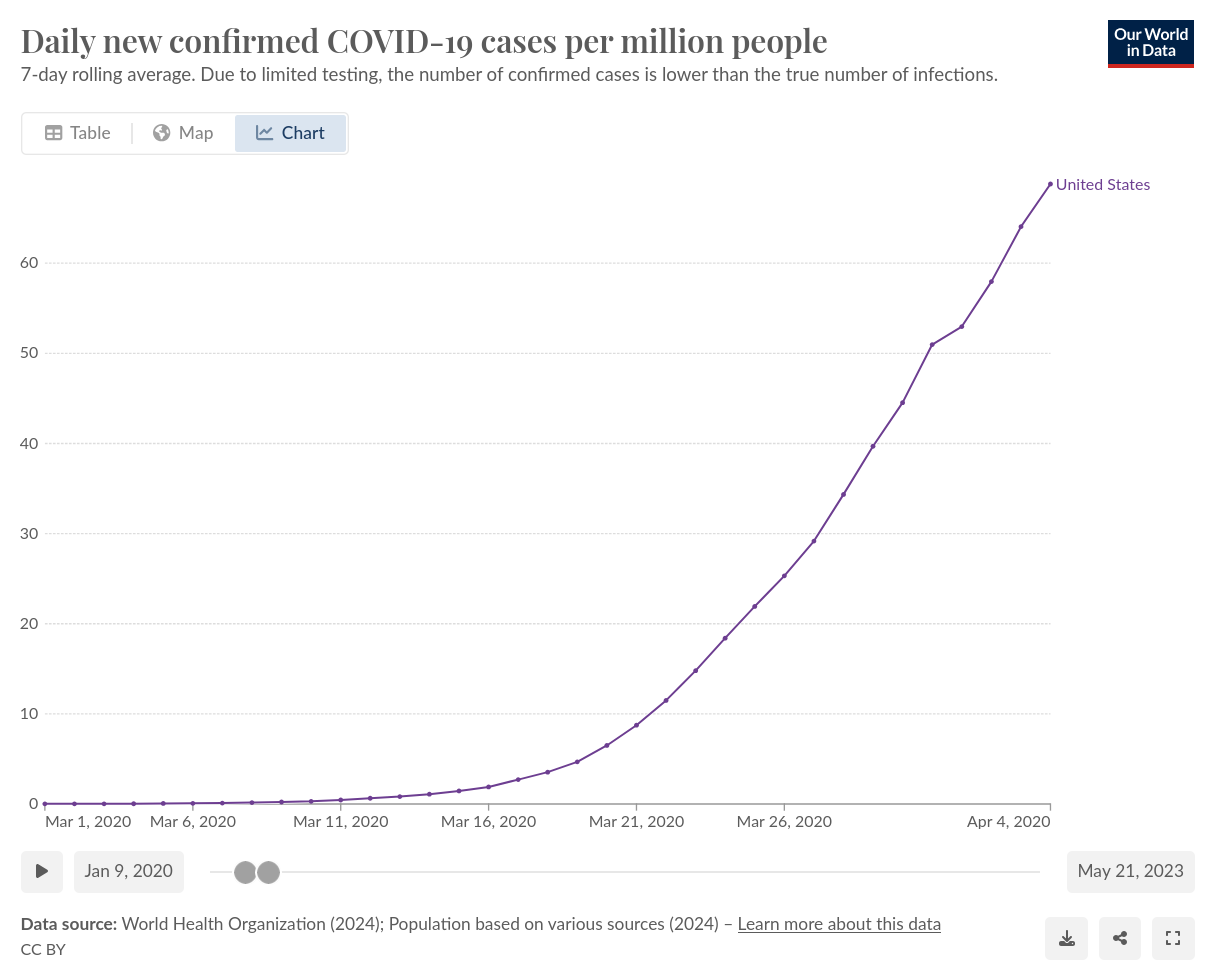
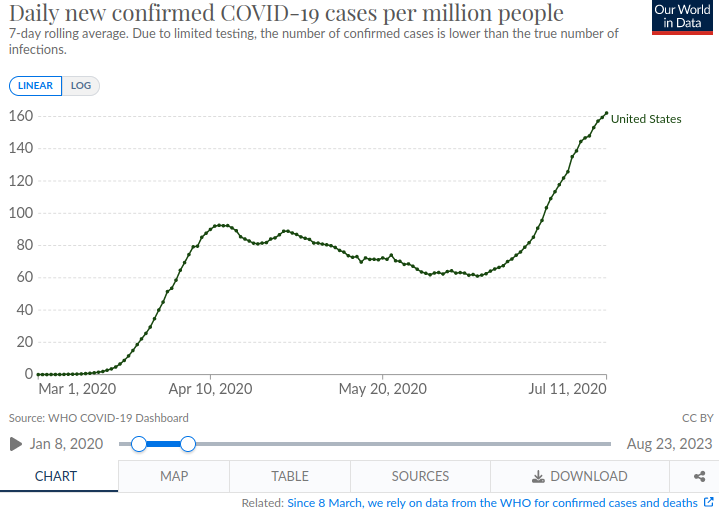
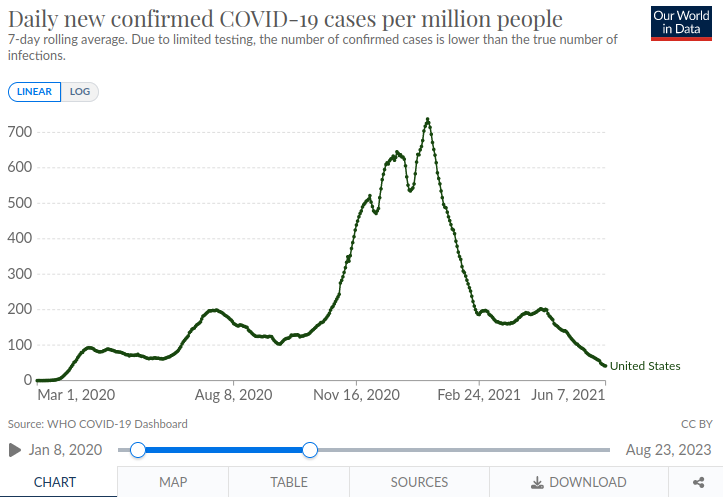
Recall that the magnitude of \(r\) determines the rate of growth
What happens when \(r = 0\)?
Equilibrium in ecology
\(r = 0\), when the rates of birth and death are equal to one another (\(b-d = 0\))
When this is true, the total number of births cancels out the total number of deaths, meaning the population size does not change.
\[\frac{dN}{dt} = rN = 0\]
This is the equilibrium state of the system.
Note that “equilibrium” doesn’t mean “nothing is changing”: there will be new births, and new deaths.
But they cancel each other, and the population size remains constant.
Equilibrium in ecology
\[\frac{dN}{dt} = rN = 0\]
This is the equilibrium state of the system.
The exponential growth model has two equilibrium conditions. One is that \(r = 0\). What is the other?
We will be exploring the equilibrium conditions for many of the models we introduce through the semester, because it has been a central concept in ecology.
How math helps us derive insights from the model
\[\frac{dN}{dt} = rN\]
- If we integrate this model, we can predict population size at any time in the future:
\[N_t = N_0*e^{rt}\]
- We can also predict how long it takes a population to double in size (‘doubling time’):
\[t_{\text{doubling}} = \frac{\text{ln}(2)}{r}\]
The exponential growth model: summary
We can imagine that the dynamics of a population (i.e. how does population size change over time?) are strictly governed by two processes: births and deaths
We can express each of these in terms of the per-capita rates of birth and death: for a given unit of time, what is the per-capita rate of reproduction and of mortality?
The net population growth is governed by the difference in birth and death rate (\(r = b-d\))
This simplest model makes some unrealistic predictions, but some useful predictions
This simplest model also makes some assumptions
The exponential growth model: assumptions
No immigration or emigration (Closed population)
Constant birth and death rate (\(b\) and \(d\) don’t vary with \(N\))
No variation within population (all individuals have similar \(b\) and \(d\))
- This implies that \(b\) and \(d\) don’t vary with age or stage
Continuous population growth without time lags
(e.g. no seasonality)
These assumptions limit the value of the model
Source: Wikimedia
” At the end of five days, the colony unchecked would thus fill all oceans of the earth with a dense microbial mass, from the greatest depths up to the surface”
“Even though this bacterial model can be quite accurate for a day or so, it fails completely over the course of a week.”