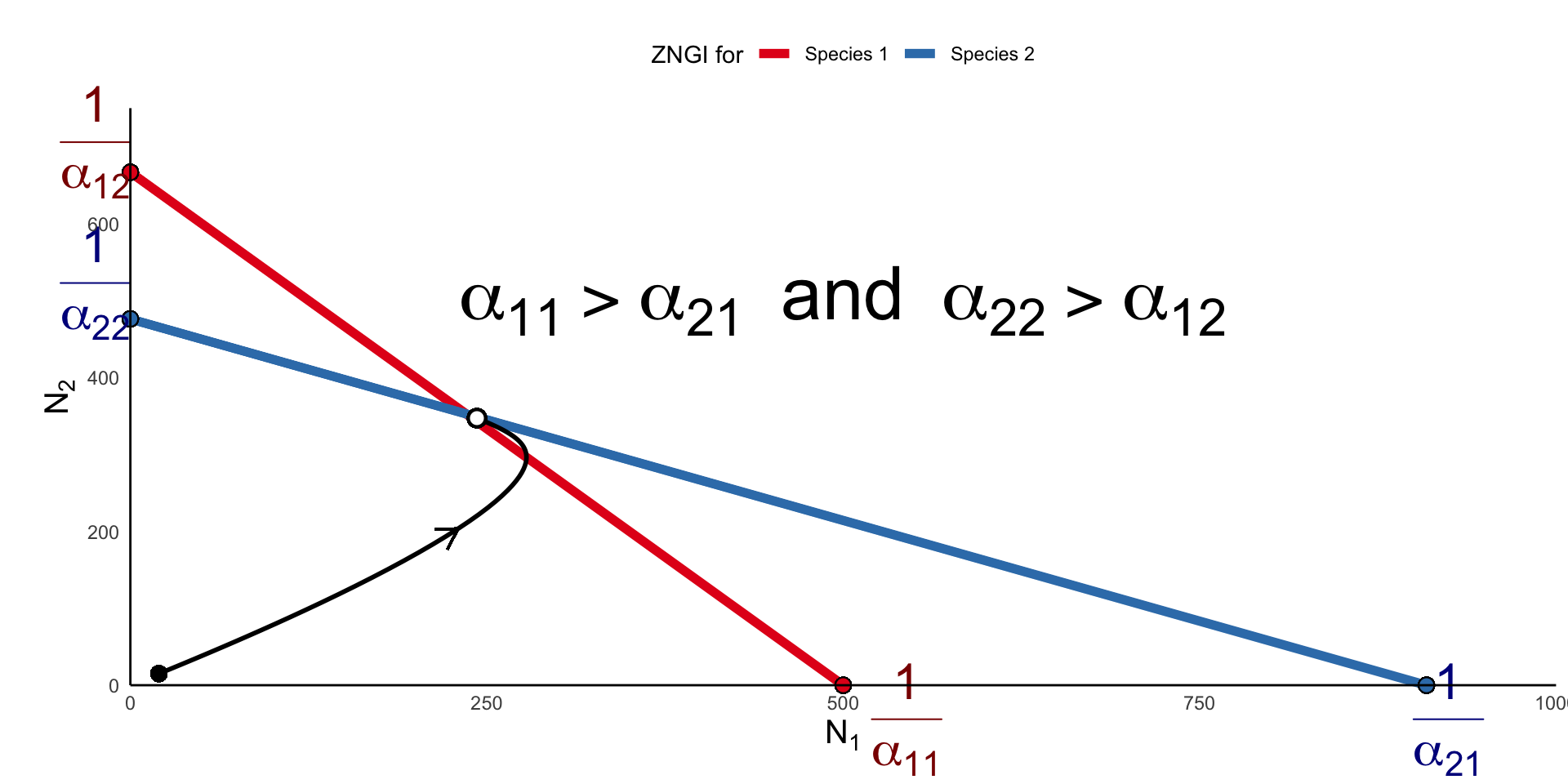
A simple model of two-species competition, con’t
Interspecific competition
Lotka-Volterra competition equations:
\[\frac{dN_1}{dT} = r_1N_1(1-\alpha_{11}N_1 - \alpha_{12}N_2)\]
\[\frac{dN_2}{dT} = r_2N_2(1-\alpha_{21}N_1 - \alpha_{22}N_2)\]
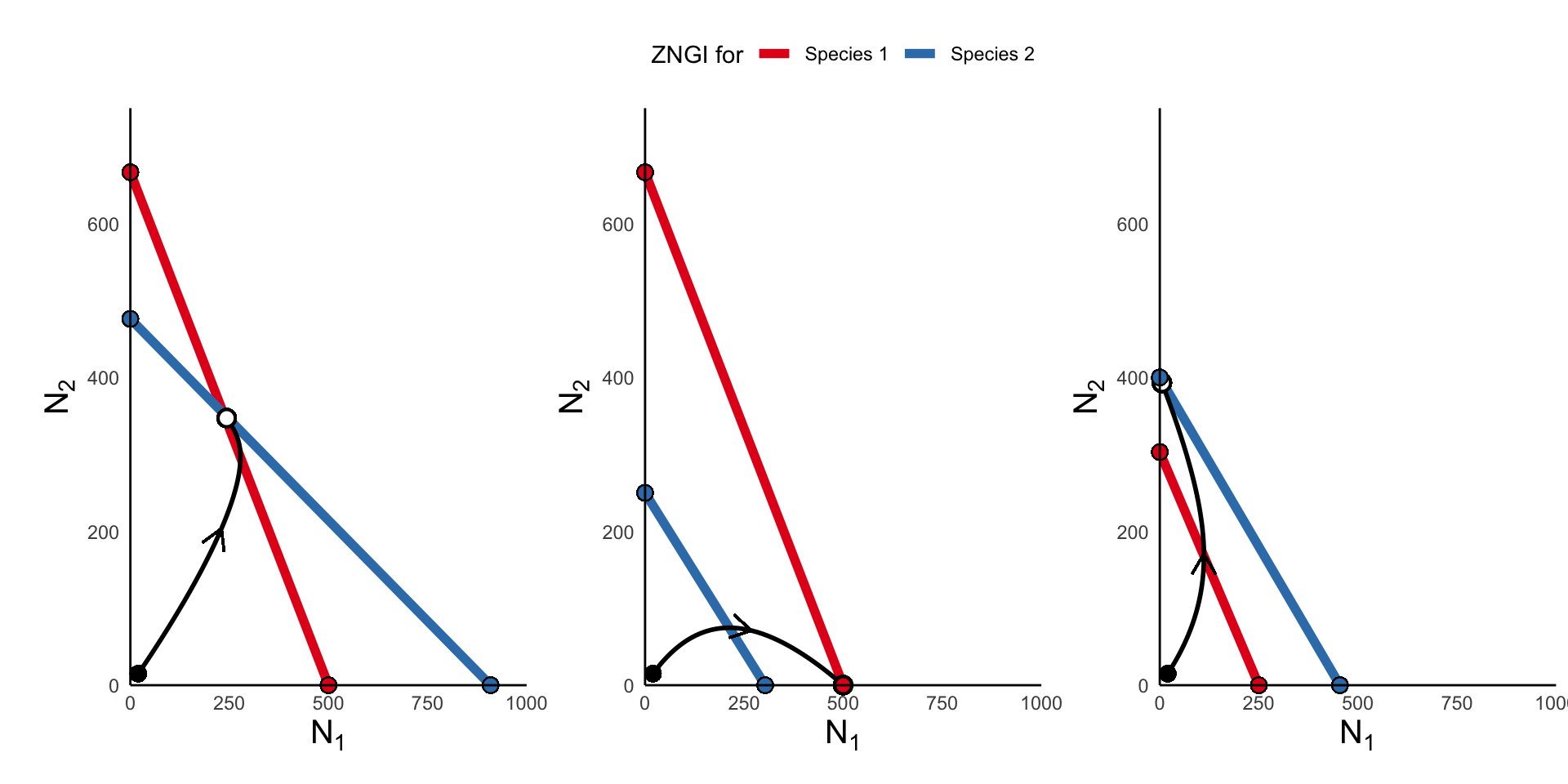
Possible outcomes of two species competing:
- Both species can have stable coexistence
- Species 1 can win, and exclude Species 2
- Species 2 can win, and exclude Species 1
- “It depends” – whichever species comes first, wins in competition.
How to distinguish between the possible options?
Zero net-growth isocline (ZNGI) analysis
Key question: Under what conditions does each species reach equilibrium?
\(\frac{dN_1}{dt} = 0\) and \(\frac{dN_2}{dt} = 0\)
Species 1’s equilibrium analysis:
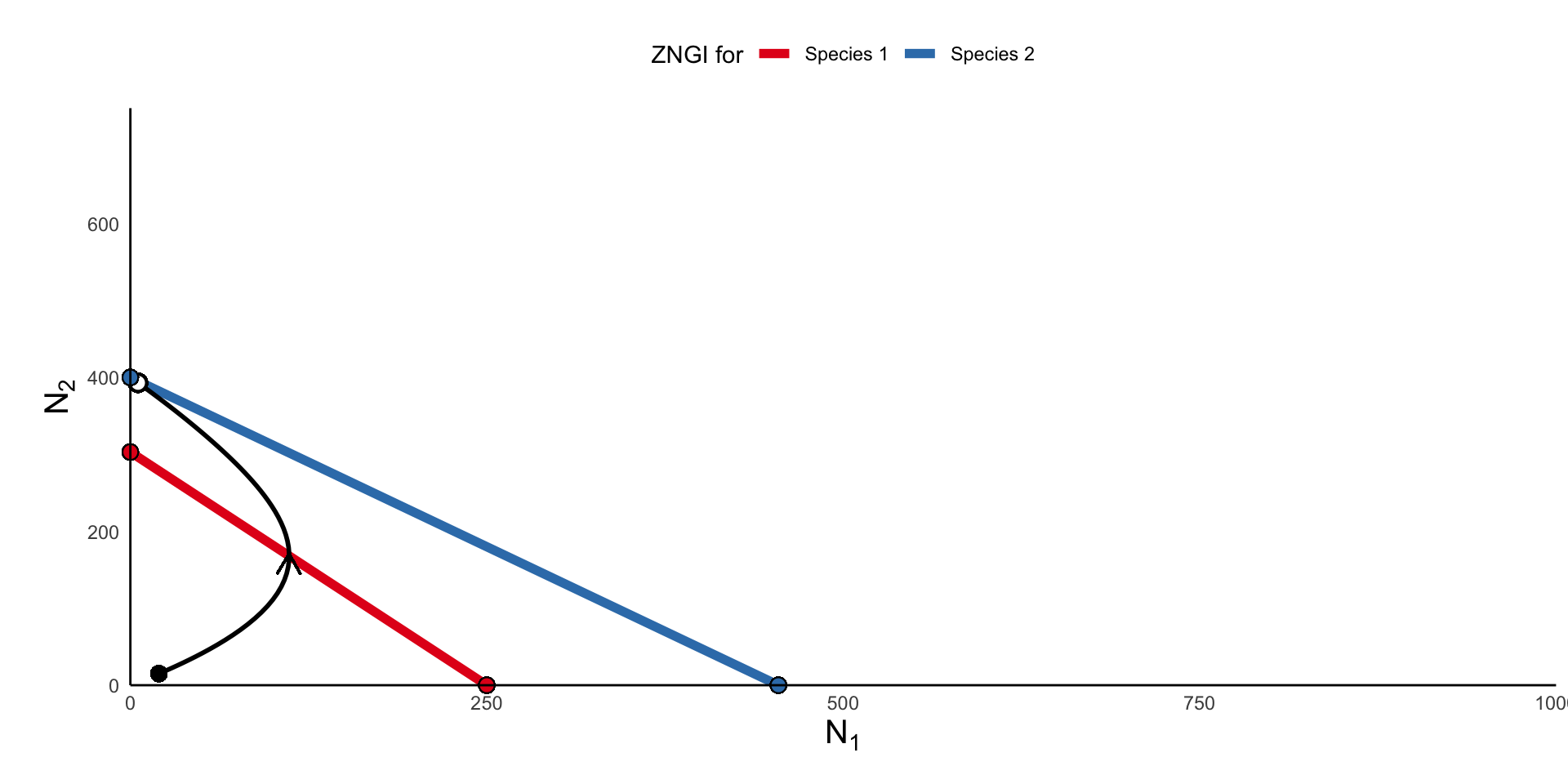
- \(\frac{dN_1}{dt} = 0\) at two extreme conditions:
- Species 1 is at its carrying capacity, and Species 2 is absent (\(N_1 = 1/\alpha_{11},~ N_2 = 0\))
- Species 2 is very abundant, and Species 1 is nearly absent (\(N_1 = 0,~ N_2 = 1/\alpha_{12}\))
- \(\frac{dN_2}{dt} = 0\) at two extreme conditions:
- Species 2 is at its carrying capacity, and Species 1 is absent (\(N_1 = 0,~ N_2 = 1/\alpha_{22}\))
- Species 1 is very abundant, and Species 2 is nearly absent (\(N_1 = 1/\alpha_{21}, ~ N_2 = 0\))
Visualizing the equilibrium points
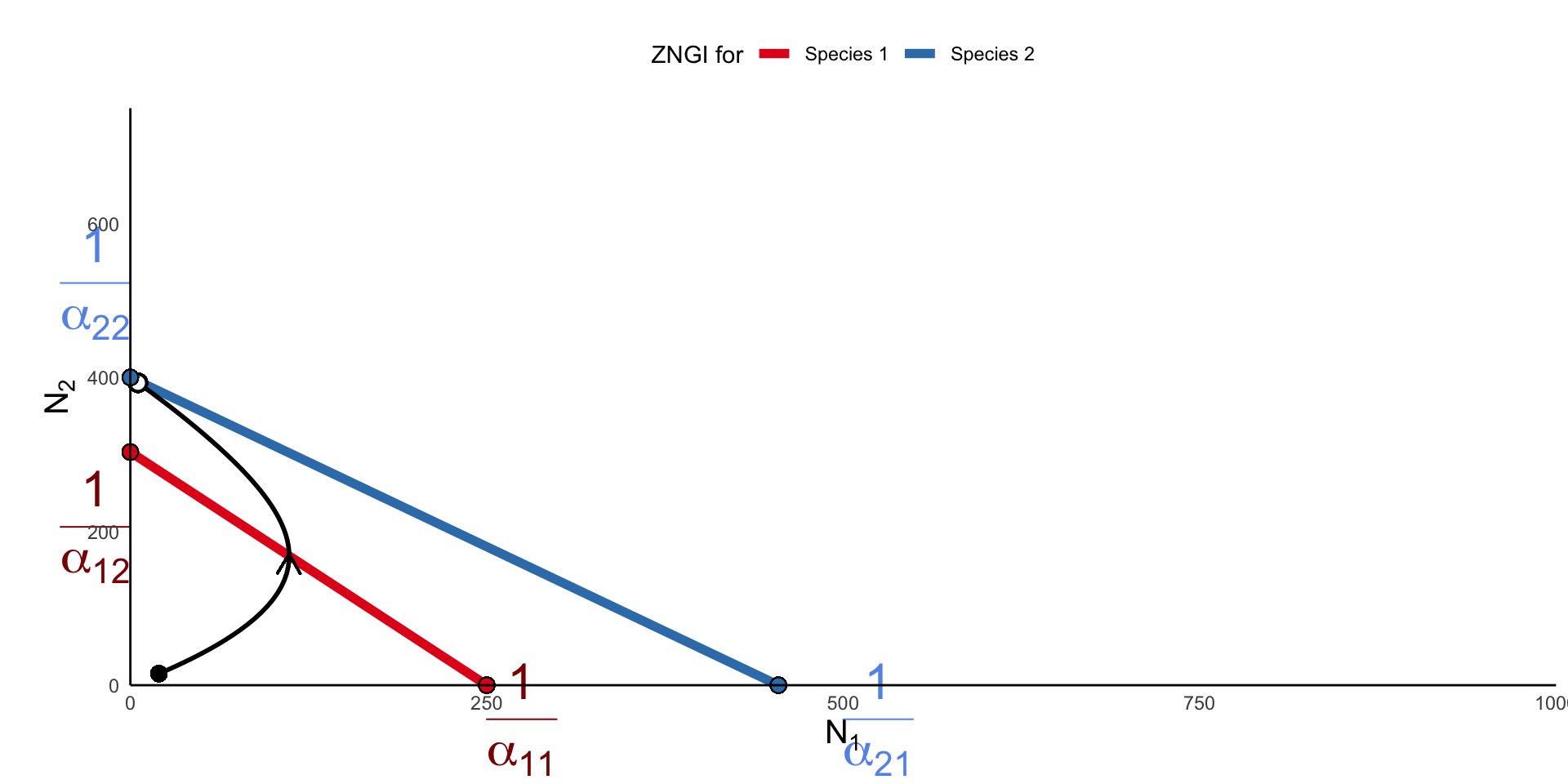
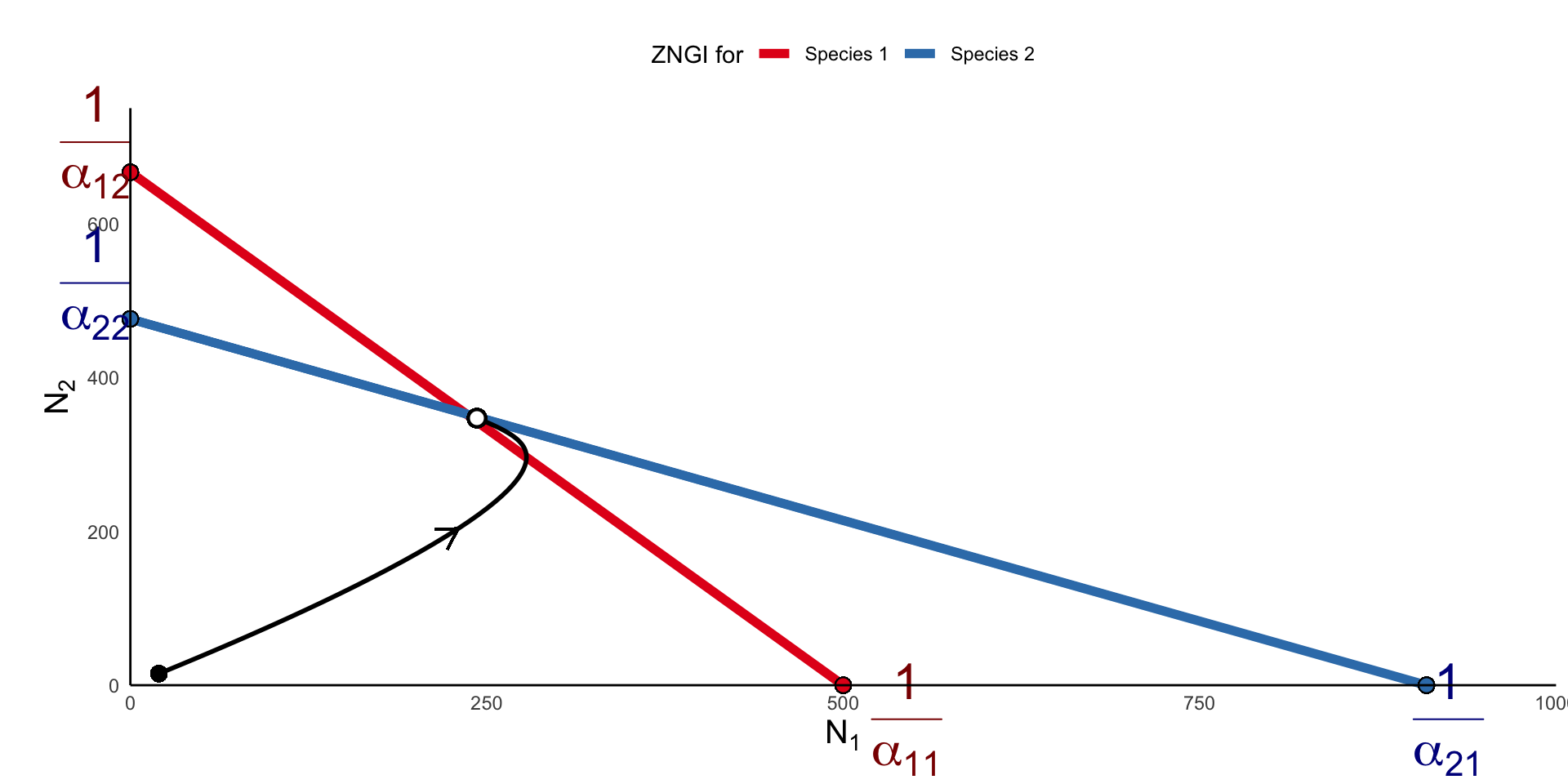
Species 1’s equilibrium analysis:
- Species 1 is at its carrying capacity, and Species 2 is absent (\(N_1 = 1/\alpha_{11},~ N_2 = 0\))
- Species 2 is very abundant, and Species 1 is nearly absent (\(N_1 = 0,~ N_2 = 1/\alpha_{12}\))
Visualizing the equilibrium points
Species 2’s equilibrium analysis:
Species 2 is at its carrying capacity, and Species 1 is absent (\(N_1 = 0,~ N_2 = 1/\alpha_{22}\))
Species 1 is very abundant, and Species 2 is nearly absent (\(N_1 = 1/\alpha_{21}, ~ N_2 = 0\))
Possible outcomes in Lotka-Volterra competition
- Both species can coexist
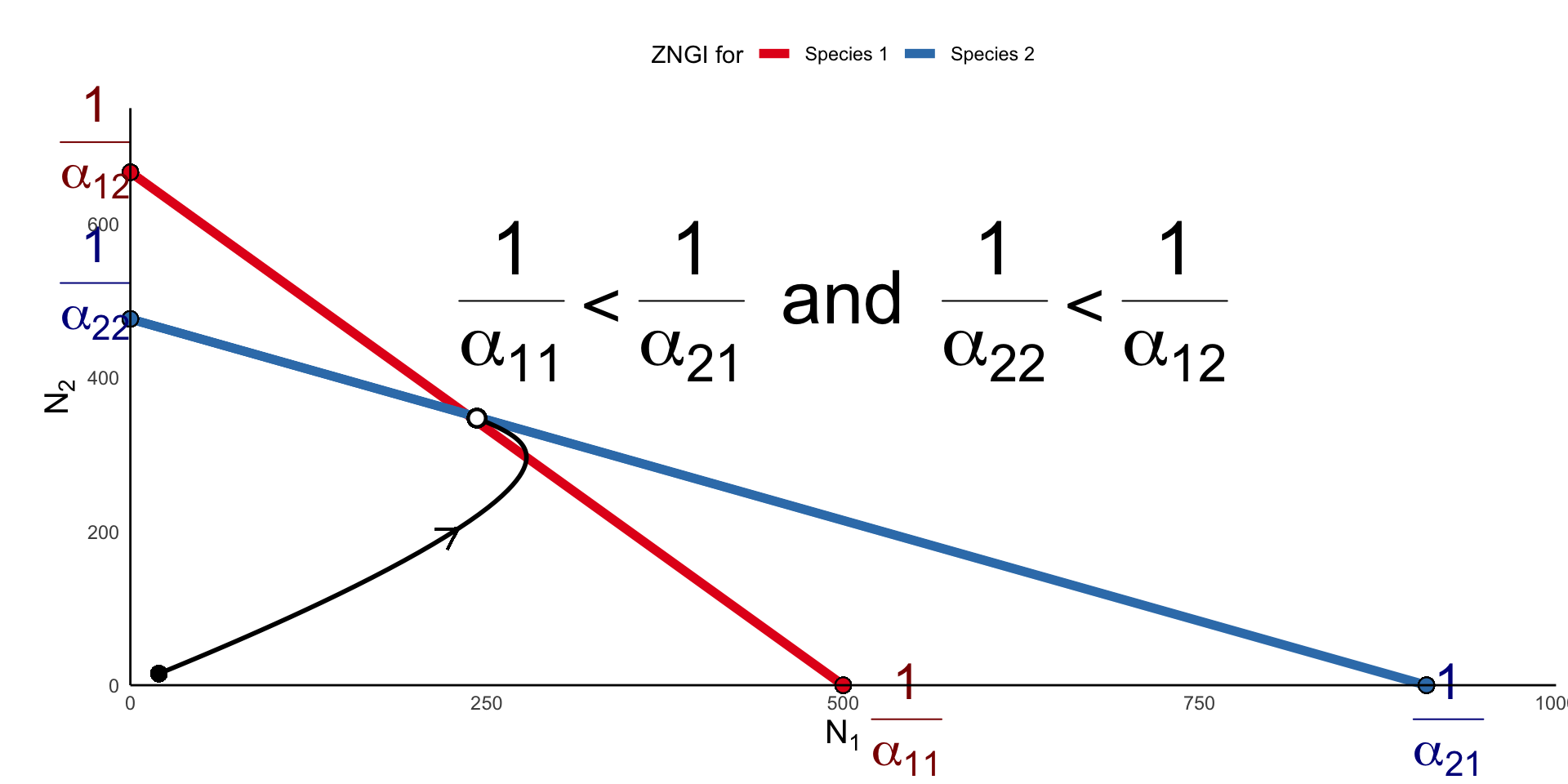
- If each species limits itself more than it limits the other
- More “intra-specific competition” than “inter-specific competition”
- Species 1 wins, while Species 2 is excluded
- Species 2 wins, while Species 1 is excluded
- “It depends”
We are often interested in understanding how it is that species can coexist
- Organisms need basically the same set of resources, yet in many systems we see lots of diversity
- Alternatively, this diversity is challenged in some systems, e.g. due to species invasions.
- So, how can competition promote coexistence?
Possible outcomes under competition:
- We also saw “it depends” as an outcome – let’s hold off on that one for now.
- What gives rise to scenario 1 (coexistence) vs. scenarios 2 or 3 (competitive dominance)?
Making sense of competitive dominance
- Let’s start with competitive dominance, as it is conceptually more straightforward
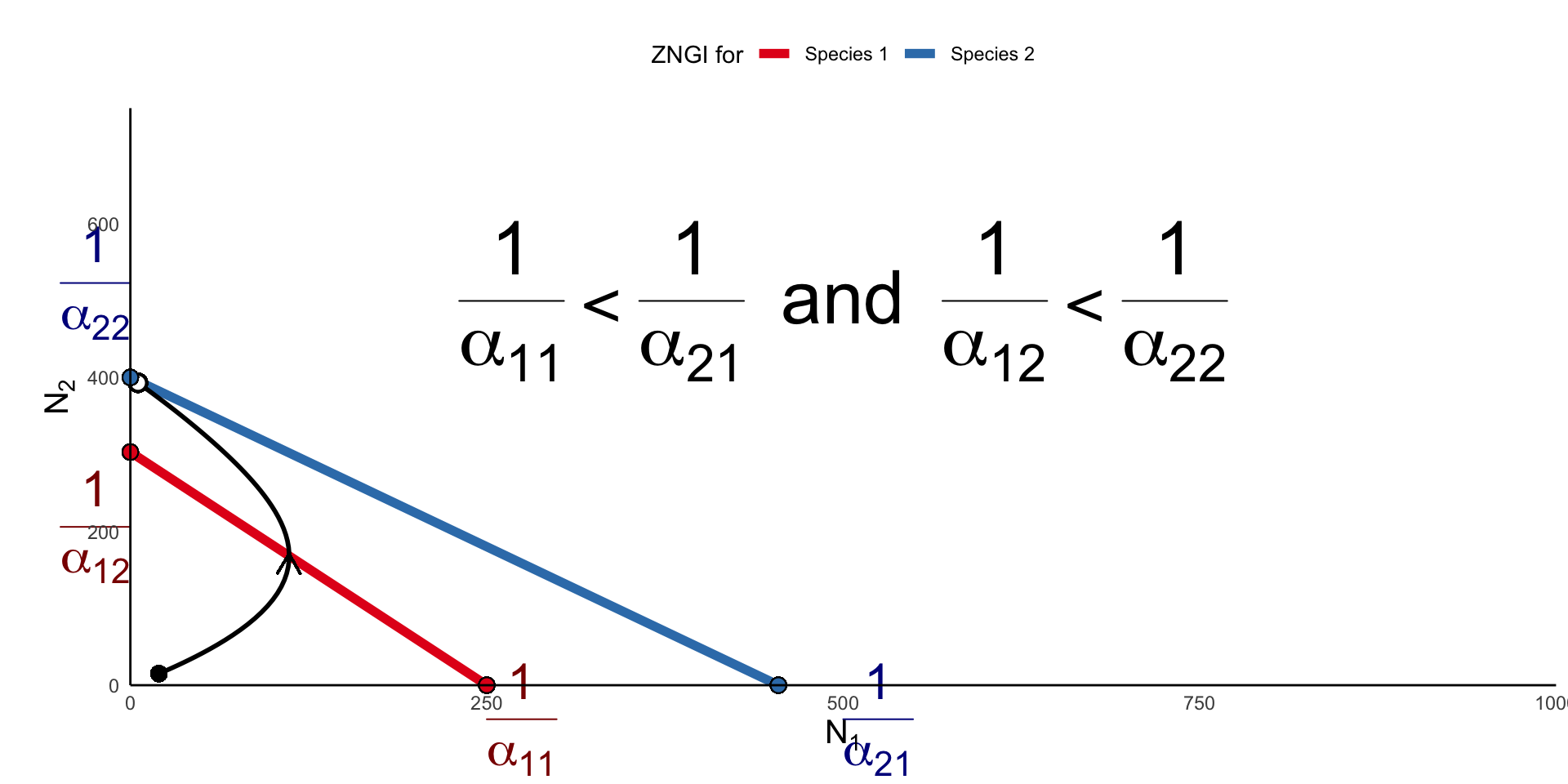
- Dominance will happen whenever one isocline is “outside” the other, i.e. no intersection
- There can be no condition under which \(\frac{dN_1}{dt} = 0\) AND \(\frac{dN_2}{dt} = 0\), which means no equilibrium possible with both species
- So, the only equilibrium points are when one species is absent.
Why would one isocline be “outside” another?
Why would one isocline be “outside” another?
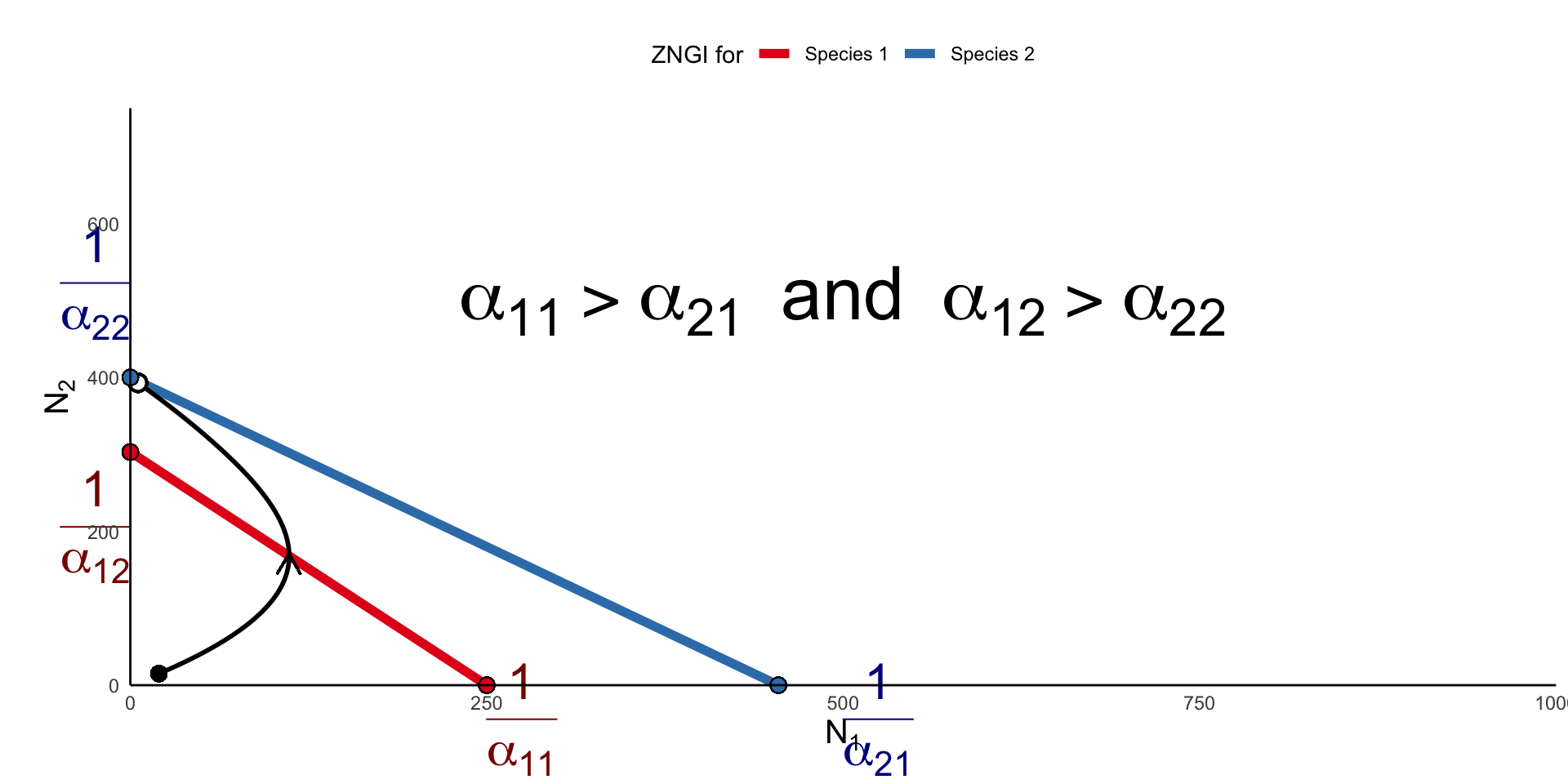
- Consider a case where species 2 “wins”:
Why would one isocline be “outside” another?
- Consider a case where species 2 “wins”:
Why would one isocline be “outside” another?
- Consider a case where species 2 “wins”:
Why would one isocline be “outside” another?
- Consider a case where species 2 “wins”:
Species 1 is strongly limited by Species 1, AND
it is strongly limited by Species 2
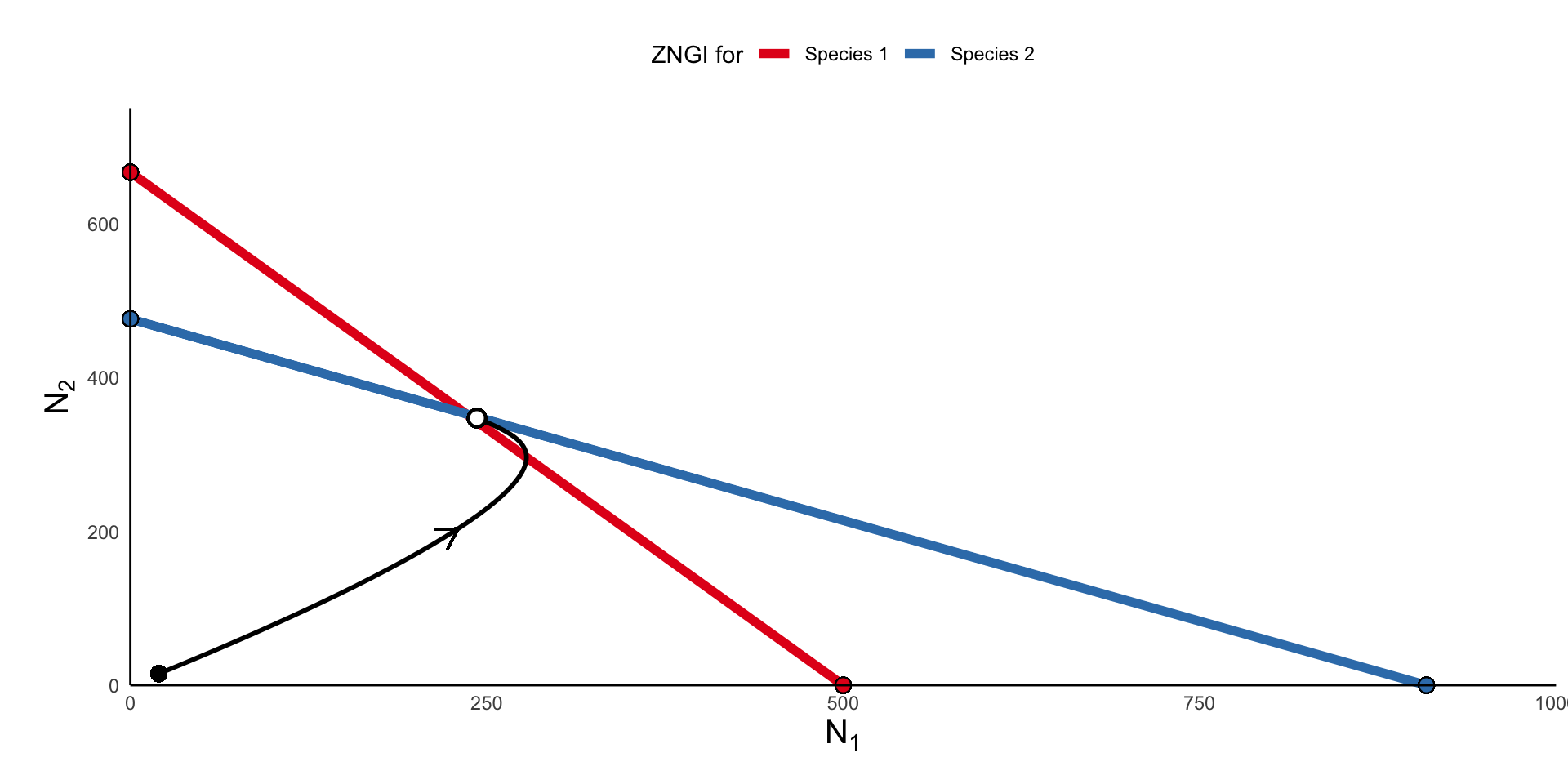
What supports species coexistence?
Let’s follow a similar logic for understanding why competition could support coexistence
What supports species coexistence?
What supports species coexistence?
What supports species coexistence?
Biologically, this means that for coexistence to occur, each species should limit itself more than it limits the other
- When would this happen?
- If species have distinct niches, competition might be stronger within a niche than between niches.
What gives rise to niche separation?
- Classically, resource separation
- E.g. two herbivore species eat grass, but each has its preferred grass
What gives rise to niche separation?
- Time is also a resource
- E.g. two plants need the exact same set of resources, but one active in early-spring and other in late-spring
What gives rise to niche separation?
- Space is also a resource
- E.g. two birds eat similar insects, but primarily hunt in distinct microhabitats