A simple model of consumer-resource dynamics
In the previous unit, we explored how a reductionist approach can be applied to the study of species competition:
What can we learn from a similar approach to consumer–resource dynamics?
Building a simple consumer–resource system
Consider the dynamics of a “consumer” species \(C\) and a “resource” species \(R\)
The resource species has plenty of resources available and can grow exponentially…
… but it is suppressed by the consumer.
The consumer is a specialist (only eats the “resource” species)
(If there is no resource around, the consumer population dies out)
The consumer loses energy at some rate (maintenance cost)
How should the abundances of consumers and resources change over time? (\(\frac{dR}{dt}\) and \(\frac{dC}{dt}\))
Resource species dynamics
- The resource species has plenty of resources available and can grow exponentially…
- … but it is suppressed by the consumer.
\[\frac{dR}{dt} = \text{exponential growth - loss to consumer}\]
\[\frac{dR}{dt} = rR - aRC\]
- \(R\) is the abundance of the resource species
- \(r\) is the intrinsic growth rate of the resource
- \(a\) is the attack rate of the consumer on the resource
- \(C\) is the abundance of the consumer species
Consumer species dynamics
- The consumer is a specialist (only eats the “resource” species)
- The consumer loses energy at some rate (maintenance cost)
\[\frac{dC}{dt} = \text{growth from consumption - energy loss}\]
\[\frac{dC}{dt} = eaRC - mC\]
- \(C\) is the abundance of the consumer species
- \(a\) is the attack rate of the consumer on the resource
- \(e\) is the efficiency with which consumer uses the energy it gets from resource
- \(R\) is the abundance of the resource species
- \(m\) is the maintenance cost of the consumer species
Lotka-Volterra consumer-resource system
\[\frac{dR}{dt} = rR - aRC\]
\[\frac{dC}{dt} = eaRC - mC\]
Some “obvious” takeaways:
- If consumer species is absent (\(C = 0\)), the resource species grows exponentially
- If the resource species is absent (\(R = 0\)), the consumer species dies out
Lotka-Volterra consumer-resource system
\[\frac{dR}{dt} = rR - aRC\]
\[\frac{dC}{dt} = eaRC - mC\]
Some more takeaways:
- If the consumer attacks the resource at a very high rate (\(\uparrow a\)), resource populations will be suppressed, and consumer population grows more rapidly
- If the consumer is very efficient at getting energy from the resource (\(\uparrow e\)), the consumer populations grow more rapidly
- If consumer has high maintenance cost (\(\uparrow m\)), consumer populations will be suppressed
Equlibrium in C-R systems
Given the consumer–resource dynamics equations:
\[\frac{dR}{dt} = rR - aRC\]
\[\frac{dC}{dt} = eaRC - mC\]
Where does equilibrium occur?
- How can we illustrate this in state-space?
Equilibrium analysis of Resource
\[\frac{dR}{dt} = rR - aRC = 0\]
\[rR = aRC\]
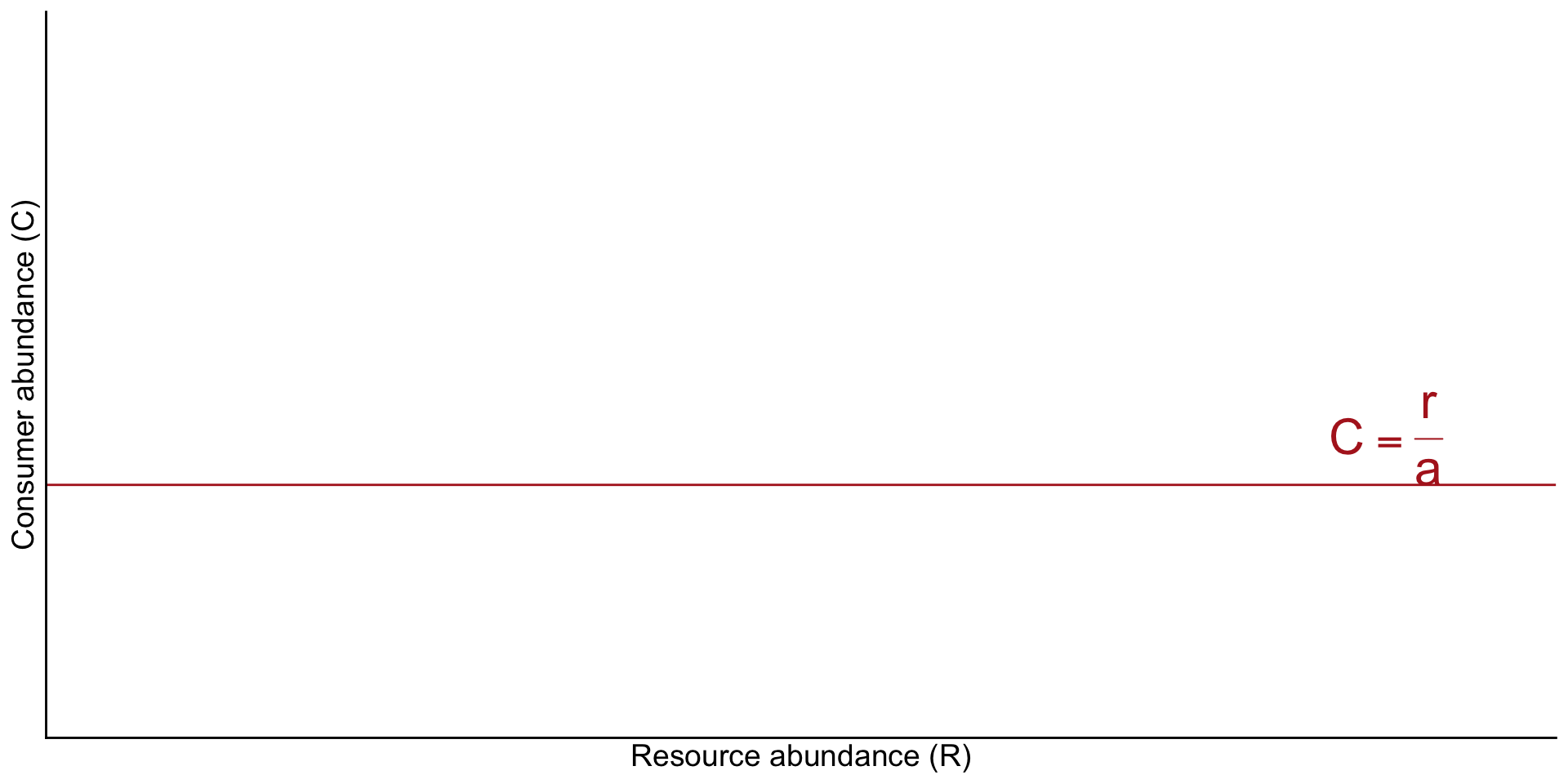
\[C^* = \frac{r}{a}\]
Interpretation: There is a set abundances of the consumer \(C\) that would cause the resource \(R\) to be at equilibrium.
- Below this threshold, the resource population can grow
- Above this threshold, the resource population shrinks
Equlibrium analysis of consumer
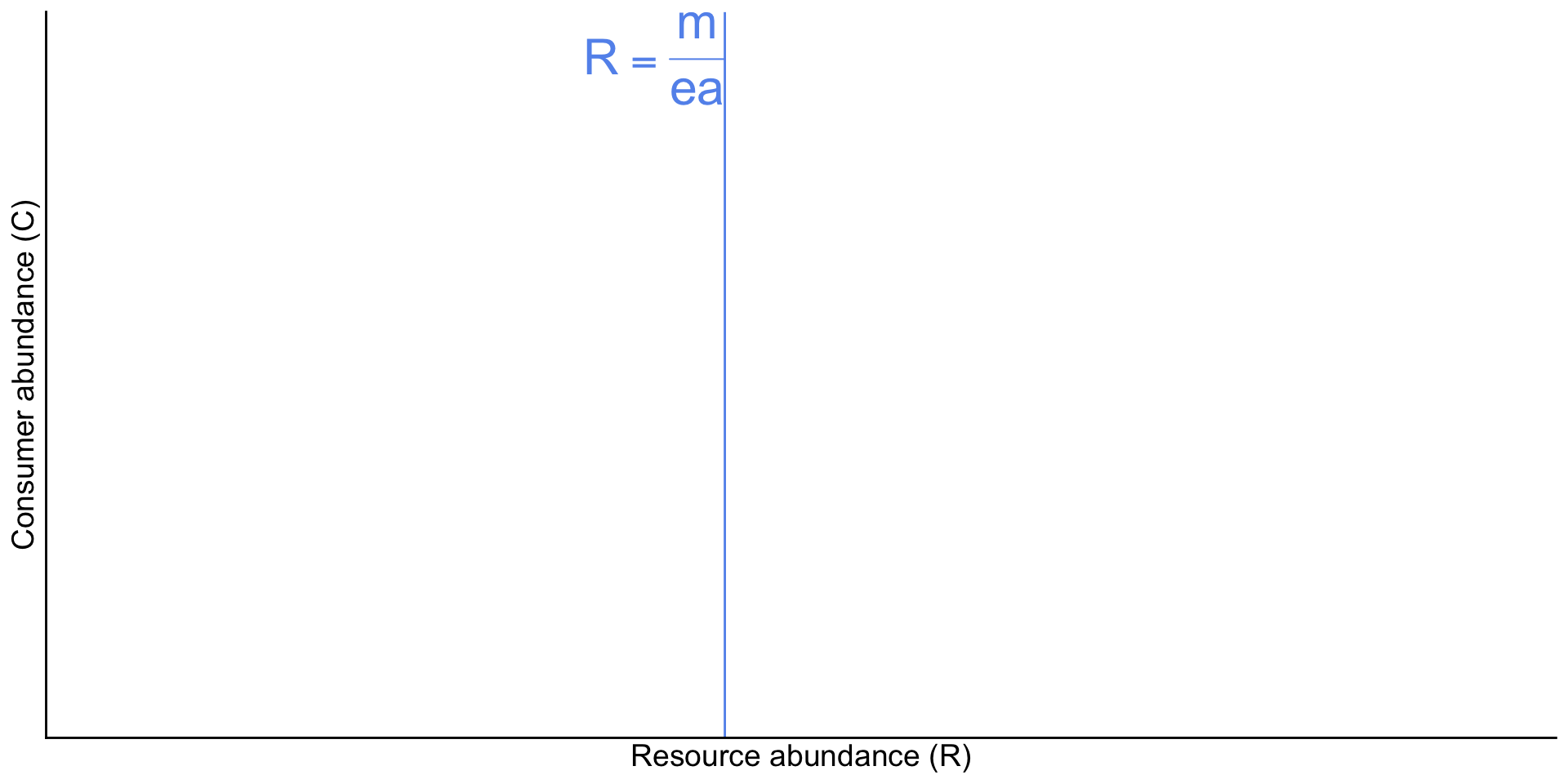
\[\frac{dC}{dt} = eaRC - mC = 0\]
\[eaRC = mC\]
\[R = \frac{m}{ea}\]
Interpration: There is a set abundance of the resource \(R\) that would cause the consumer to reach equilibrium
- Below this threshold, the consumer population shrinks
- Above this threshold, the consumer population can grow
Putting the isoclines together
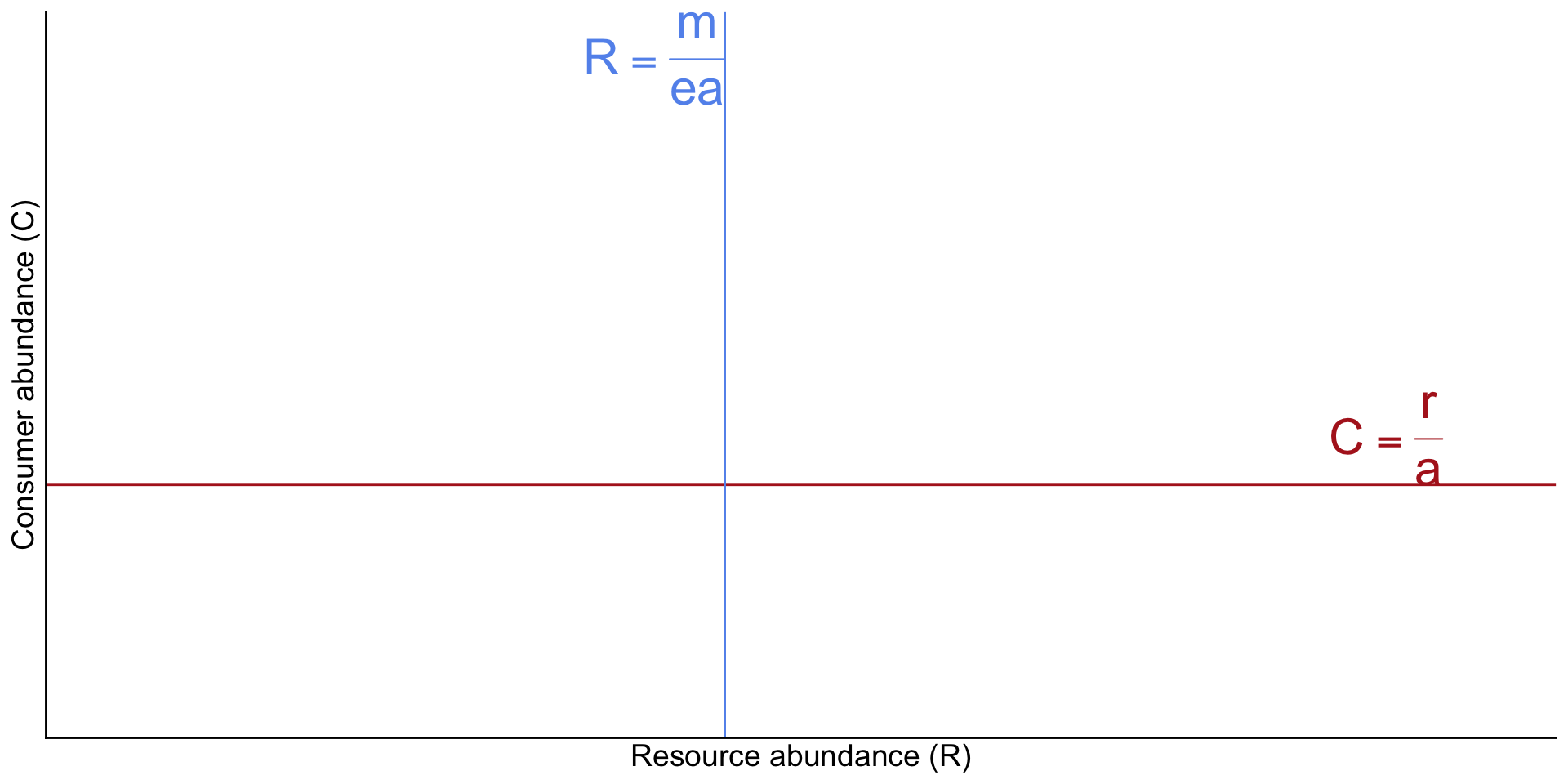
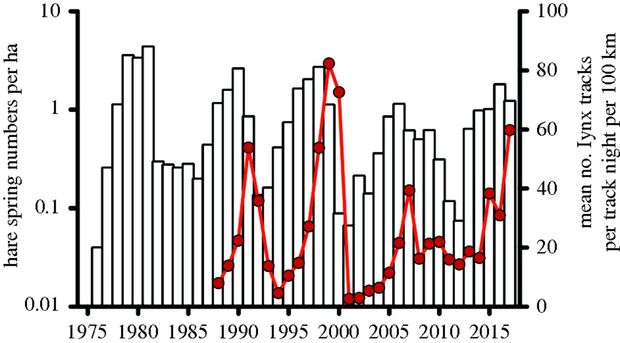
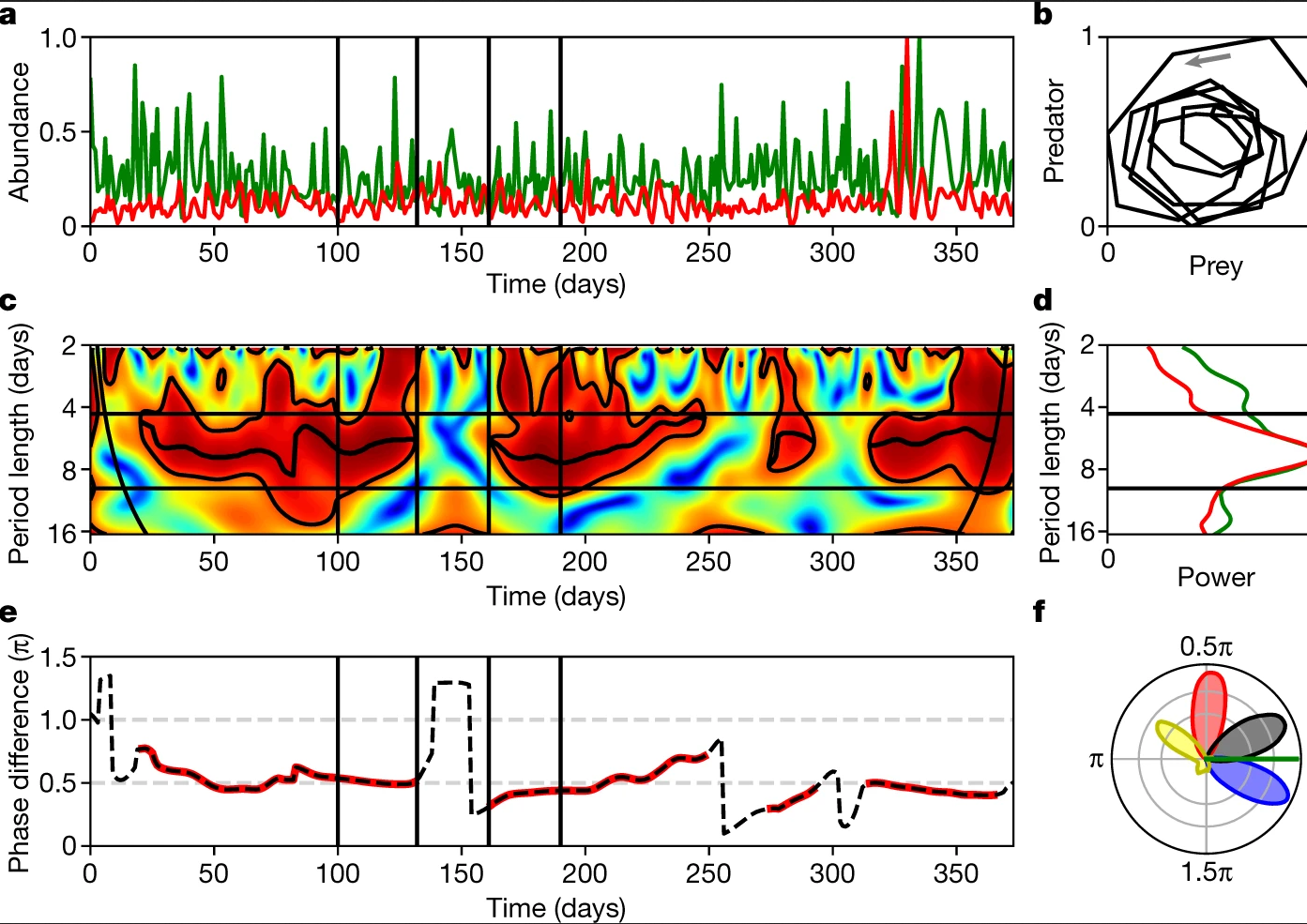
This suggests that populations should cycle. Do they?
Population cycling in nature